




Software updates are inevitable, but with every change comes the risk that something might break. Regression testing is the process of re-running test cases to ensure that recent changes do not break existing functionality.
In the modern development landscape, teams face a dilemma: Agile sprints are designed for speed and flexibility, but moving fast increases the risk of accidental defects. A solid regression test strategy safeguards core functionality while enabling continuous delivery, preventing new changes from becoming a bottleneck.
The Business Case: Why You Need a Strategy Now
The Hidden Cost of Manual Regression
Manual regression feels simple on the surface, but it eats budget and quietly slows release velocity. To understand the urgency of a strategy, you must look at the financial impact. A simple formula to estimate your quarterly spend is:
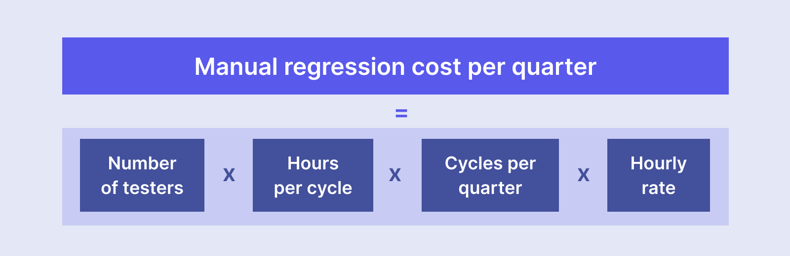
For example, if you have 5 testers, each cycle takes 30 hours, you run 4 cycles per quarter, and the average hourly rate is $50.
The math is stark: 5 testers × 30 hours × 4 cycles × $50/hour = $30,000 per quarter. That equates to $120,000 per year just to rerun old test cases manually.
The Release Velocity Tax
Beyond direct labor costs, manual regression acts as a release delay multiplier. Every extra testing day is a day your new features wait to reach users. If a team spends three days per sprint on manual regression, that adds up to nearly a full month of lost time over twelve sprints.
Manual vs. Automated ROI
Manual regression costs grow linearly with your product's complexity and team size. In contrast, automated testing requires an upfront investment but stabilizes costs once set up, creating repeatable value every cycle. Slower feedback loops from manual testing delay release schedules and revenue impact, whereas automation accelerates time-to-market.
The Quality Gap
In 2026, the cost of manual regression isn't just about labor hours; it's about the Customer Experience (CX) Gap. According to Emplifi research cited by Webex, 70% of customers will abandon a brand after just two bad experiences, while The Futurum Group reports that 72% switch after three or fewer poor interactions.
While manual regression costs grow linearly with product complexity, escaped defects trigger a cascade effect—customer churn, negative reviews, and brand damage that far exceeds the cost of early detection.
Choosing Your Regression Approach
There is no one-size-fits-all approach, but most strategies fall into specific categories:
Static vs. Dynamic
Static testing focuses on reviewing code and artifacts without execution, while dynamic testing involves running manual or automated tests to observe system behavior.
Preventive vs. Reactive
Preventive strategies plan for risk and build coverage into the development flow, whereas reactive strategies catch late-stage issues or bugs found in production.
The Recommended Approach: Hybrid & Agile
The most effective strategy is a hybrid approach that combines manual exploratory testing with automation. This allows you to validate changes quickly while reserving human attention for complex analysis.
In an Agile environment, you must shift left by involving QA in backlog grooming and sprint planning. Treat test creation as part of story completion rather than an afterthought. This collaborative testing ensures that regression coverage is proactive rather than reactive.

Building the Plan: A 7-Step Framework
Step 1: Define Scope & Risk (The "What")
You cannot test everything all the time. Before prioritizing, you must first understand exactly what changed: was it a bug fix, a new feature, an enhancement, or a configuration update? This context directly informs your risk assessment.
Once changes are identified, adopt a risk-based approach to focus efforts on what is most likely to break or hurt the business. Categorize tests into tiers:
-
High Risk: Core user flows (e.g., Checkout, Login), payment processing, and defect-prone areas.
-
Medium Risk: Integration points, data boundaries, and edge cases.
-
Low Risk: Rarely touched backend logic or internal tools. Focus your regression testing on these high-risk zones and the immediate dependencies of modified components.
Download now: Regression Test Plan (Free Excel Template): The Ultimate Starter Kit
Step 2: Set Entry & Exit Criteria
Clearly document when to start and stop testing to ensure efficiency.
-
Entry Criteria: Successful completion of smoke tests, a stable build environment, and available test data.
-
Exit Criteria: 100% execution of prioritized tests, zero critical bugs remaining open, and a pass rate that meets your quality thresholds (e.g., 95%).
Step 3: Define the Test Levels (The Pyramid)
Use the test pyramid to structure your suite. Aim for 70-80% Unit tests, 15-20% Integration tests, and 5-10% End-to-End tests. This ensures you prioritize speed at the base while scaling upward only for high-value flows.

Read more: Test Pyramid Explained: Strategy, Levels & Examples
Step 4: Environment & Data Strategy
Testing in shared or unstable environments leads to inconsistent results.
Isolate the System Under Test (SUT): Use Docker or ephemeral environments to prevent flakiness. Mock third-party dependencies like APIs and payment gateways so that failures are due to your code, not external downtime.
Data Management: Avoid massive, fragile production dumps. Instead, use modular, composable data snippets. Determine if Static Test Data (pre-defined snapshots) or Dynamic Test Data (generated on-the-fly) best fits your needs to reduce conflicts.
Step 5: Automation Strategy
Do not try to automate everything at once. Start with the most critical paths and build up over time. Aim for 70–90% automation, leaving complex or visual scenarios for manual exploratory testing. This balance allows you to move fast without breaking things.
Step 6: CI/CD Integration & Reporting
Integrate regression tests early in the pipeline. Run tests automatically at the Pull Request or pre-merge stage to catch defects before they impact staging or production.
Implement gatekeeping policies, such as blocking merges if critical tests fail. Leverage dashboards to track pass rates, flaky tests, and defect trends in real time.
Step 7: Maintenance (The "Cleanup")
Maintenance is often where automation efforts collapse. To scale past this "ROI Wall", teams must pivot away from manual, scripted flows based on often-ambiguous requirements. Instead, the modern approach leverages AI-driven self-healing and real-user behavior analysis to maintain stability and relevance.
To succeed, your regression suite must evolve in tandem with your codebase. Implementing a habit of. "Sprint Pruning", the practice of retiring obsolete tests and adding new ones after every sprint, is essential for long-term health. By committing to regular refactoring, you ensure the suite remains lean and efficient, preventing it from becoming a bottleneck in your delivery pipeline.

Execution: Best Practices for Efficiency
To maximize the value of your regression strategy, adopt these industry-proven best practices to maintain speed, coverage, and quality.
Optimize Scope via Risk & Rotation
Sometimes you cannot test everything. Prioritize high-risk areas (e.g., login, checkout) and recent code changes while rotating lower-priority tests to ensure broad coverage over time.
Use code coverage tools to find gaps and analyze past production bugs to target specific weak spots, ensuring you are testing where the risk actually lies.
Automate & Integrate (CI/CD)
Focus automation on stable, repetitive paths to free up testers for exploratory work. Integrate these tests directly into your CI/CD pipeline to act as immediate gatekeepers, catching defects at the pull request stage rather than weeks later.
Stabilize the Test Ecosystem
Eliminate flaky tests by ensuring environment integrity. Isolate the System Under Test using containers (like Docker) and use fresh, dedicated test data for every run. This ensures that failures are caused by actual code defects, not dirty data or shared environment noise.
Maintain & Align (Shift Left)
Treat your test suite like code: regularly prune obsolete tests and update existing ones to keep the pack lean. Shift left by aligning Dev and QA during the design phase, turning regression testing into a verification step rather than a bug-hunting expedition.
Measuring Success: Metrics That Matter
To validate your strategy, aim for the benchmarks set by high-maturity teams. According to Katalon’s 2025 State of Software Quality Report, organizations that successfully integrate AI-driven regression see 24% lower operational costs and 32% higher customer satisfaction. Additionally, 48% of organizations now view QA as a competitive advantage.
-
Cost & Velocity: Monitor Test ROI (manual effort saved) and Time to Release.
-
Quality Metrics: Track Defect Leakage (bugs missed), Flaky Test Ratio, and Pass/Fail trends.
-
Stopping Criteria: One of the hardest parts of regression is knowing when to stop. Use Bug Discovery Rates and Test Pass Trends to decide. If the bug find rate drops significantly and the pass rate stabilizes, it is time to conclude testing.
Conclusion
Manual regression is a costly bottleneck, and in 2026, a strategic approach is a business necessity. With 70% of customers abandoning a brand after just two bad experiences (Emplifi), you can no longer afford a "wait and see" model. By blending automation with risk-based Agile workflows, you transition from reactive fixing to proactive quality, ensuring speed without sacrificing safety.
To scale past the "ROI Wall", Katalon Studio offers the AI-driven tools needed to streamline maintenance, reduce test debt, and integrate seamlessly into CI/CD pipelines. Turn your quality process into a primary competitive advantage and deliver every release with confidence.

|
