



Most test automation tools are sized for one kind of team. The ones a lean QA group can adopt inside a quarter tend to buckle when a compliance officer asks who approved a change and when. The ones large enterprises standardize on often need a dedicated platform team before anyone writes a single test. Anyone who has evaluated tooling knows the feeling of reading a glowing review and realizing it was written by someone at a company nothing like theirs.
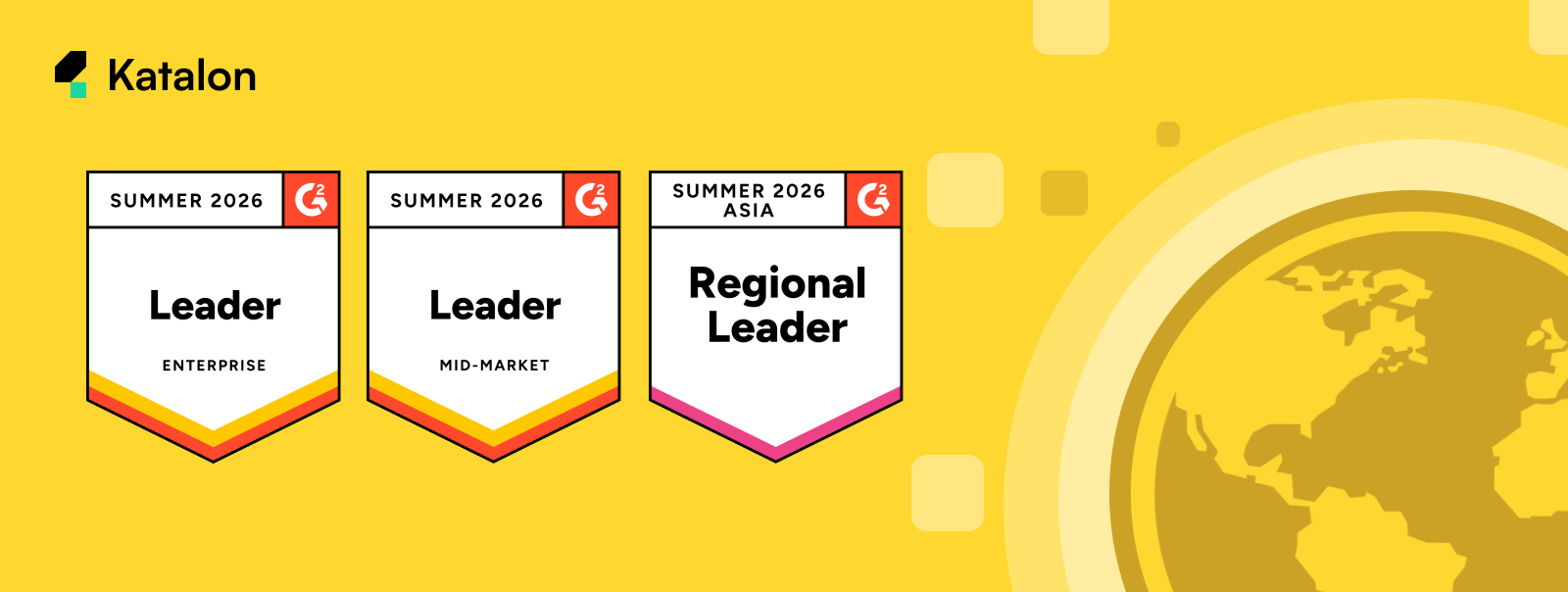
That is what makes G2's Summer 2026 results worth more than a badge. Katalon is a Leader in the Automation Testing Grid for Mid-Market and for Enterprise, and a Regional Leader for Automation Testing in Asia. Two segment reports, scored from reviews written at two different sizes of company.
SUMMARY
Katalon's G2 Summer 2026 results, at a glance:
• Leader in the Automation Testing Grid for Mid-Market, covering companies of 51 to 1,000 employees.
• Leader in the Automation Testing Grid for Enterprise, covering companies of 1,001 employees and up.
• Regional Leader for Automation Testing in Asia.
• 39 badges in total across Automation Testing, DevOps, and Software Testing.
• Each segment Grid includes only reviews from reviewers at companies in that size band, so the Mid-Market and Enterprise results come from different sets of reviewers.
The rest of this article covers how G2 builds these reports, and the themes that come up in reviews from each segment.
What Katalon earned in G2's Summer 2026 reports
Three badges anchor this cycle.
| Who it covers | Report | |
|---|---|---|
| Leader, Mid-Market | Companies with 51 to 1,000 employees | Grid Report for Automation Testing, Mid-Market, Summer 2026 |
| Leader, Enterprise | Companies with 1,001 employees or more | Grid Report for Automation Testing, Enterprise, Summer 2026 |
| Regional Leader, Asia | All company sizes, reviewers based in Asia | Regional Grid Report for Automation Testing, Asia, Summer 2026 |
Across the full Summer 2026 cycle, Katalon earned 39 badges in three G2 categories: Automation Testing, DevOps, and Software Testing. You can see Katalon's customer reviews on the Katalon profile on G2.
The badge count is the least interesting part. What the two segment badges mean is the part worth reading.
Why the two segment reports are worth separating
It helps to know how G2 builds these reports, because the structure is more specific than the badges suggest.
G2 sorts companies into segments by employee count: Small Business is 50 employees or fewer, Mid-Market runs from 51 to 1,000, and Enterprise starts at 1,001. In G2's own description, a segment Grid "only includes reviews from reviewers who are employed by a company within a particular market segment." Because the Mid-Market and Enterprise bands do not overlap, the two reports draw on different groups of reviewers.
Placement on each Grid comes from two axes. Satisfaction is calculated from review scores, weighting ease of use, whether the product meets requirements, and quality of support most heavily, with older reviews losing influence over time. Market Presence combines review volume with external signals like company size and web authority. Leaders are the products that score highly on both. G2 also sets a floor for publishing a Grid at all: the category needs at least 150 reviews, with at least six products carrying 10 or more reviews each.
So a Leader placement in both Mid-Market and Enterprise is not one result presented twice. It is two reports, scored from reviews written at two different sizes of company, in a category with enough review volume for the comparison to mean something.
The interesting question is what reviewers in each segment tend to write about, because the emphasis is not the same.
Themes we see in mid-market reviews
Read through reviews from mid-market companies and a consistent emphasis emerges. These are teams without a dedicated platform engineering function behind them, where time spent building and maintaining test infrastructure is time not spent testing, and there is often no separate team to hand that work to.
The theme that recurs most is that testers can contribute without first learning a framework. Reviewers describe low-code test creation, built-in keywords, and the object repository as what lets someone who has not written automation before produce a working script.
Alongside that, reviewers frequently mention covering web, mobile, API, and desktop in one tool rather than assembling and maintaining separate stacks, and getting CI/CD integration with tools like Jenkins, GitHub, and Azure DevOps without building connectors themselves.
That emphasis lines up with what mid-market QA teams tell us elsewhere. In Katalon's State of Software Quality Report 2025, 55% of respondents named insufficient time for testing as their biggest challenge, and 50% said their organization struggles to fund the automation tools they need. When time and budget are both constrained, the deciding factor is less about how powerful a tool becomes at full maturity, and more about how much work is required before it does anything useful.
Themes we see in enterprise reviews
Reviews from enterprise companies read differently, because the constraint is different. At this size, QA is typically distributed across business units, often with outsourced delivery partners involved. The concern is less about writing a first script and more about what happens when many teams are writing and maintaining them at once.
The themes that recur here are centralized test management and reporting that give leadership a view across distributed teams, fitting into an existing DevOps toolchain rather than replacing it, with Jira, Jenkins, and Azure DevOps named repeatedly, and coverage across web, mobile, API, and desktop within one contract rather than several. Responsiveness of support also comes up more often in enterprise reviews than in mid-market ones, which is unsurprising when a rollout crosses business units.
There is a reason governance features so heavily in enterprise conversations right now. Capgemini's World Quality Report 2025-26, based on responses from more than 2,000 senior executives across 22 countries and 10 sectors, found that 89% of organizations are piloting or deploying generative AI augmented workflows, but only 15% have achieved enterprise-wide implementation, with 43% still in the experimental phase. The barriers respondents named most often were data privacy risks at 67%, integration complexity at 64%, and hallucination and reliability concerns at 60%.
That is the distance between an AI feature that demos well and one an organization will run across the business. It is also a reasonable explanation for why enterprise reviewers write about control and traceability while mid-market reviewers write about getting started. Both groups are describing the same product, from different starting positions.
One platform, two different definitions of "it works"
What connects the two sets of reviews is that they respond to the same design choice.
As set out in the True Platform launch announcement, Katalon True Platform is built as a unified software quality platform that combines purpose-built AI agents with the governance, traceability, and human oversight that AI-driven development demands. The intent is that tests are authored, run, managed, and reported on within one platform, rather than across a set of separate tools joined by custom integration work.
A mid-market team tends to notice that choice as work they did not have to do. They did not build a framework, integrate several vendors, or staff someone to maintain the connections between them. An enterprise team tends to notice the same choice as visibility. When the work runs in one platform, there is one place to manage access and report on testing activity.
Same design decision, two different things to like about it, described by two groups who would frame their problem in different words. That is the through-line in the Summer 2026 results.
You can see the pieces in Katalon Studio for authoring, Test Management for planning and traceability, the Test execution cloud for scale, and Production Insights for what real users do once software ships.
Regional recognition in Asia
Katalon was also named a Regional Leader in the Grid Report for Automation Testing, Asia, Summer 2026, a report covering reviewers in that region across all company sizes.
Alongside it, Katalon earned regional Leader placements in the Asia Pacific and India reports for both Automation Testing and DevOps: four further badges, each covering all company sizes in its region.
Thank you, genuinely
None of this is written by us. G2 badges are earned from reviews submitted by people who validate their identity with G2 before a review is published, and who took the time to describe what a tool did and did not do for their team. Several of the reviews behind these badges are specific enough to be uncomfortable, which is exactly what makes them useful to the next person reading them.
If Katalon has changed how your team works, leaving a review on G2 is one of the more useful things you can do for the QA engineer currently three tabs deep in an evaluation, trying to work out whether a tool that suits a large enterprise will suit their team of twelve.
And if you are that engineer: you can book a demo and find out directly.

|
