




A business case for test automation is easiest to make with a concrete example, and e-commerce provides one of the clearest: checkout, inventory, and payment flows all have to hold up under peak-season traffic, and a bad release during that window costs revenue in minutes, not days.
This guide walks through how to build that business case: the real cost of manual testing at retail scale, why downtime and performance risk raise the stakes during peak season, a general ROI framework, and how to map automation's value to the KPIs your leadership team already tracks. E-commerce is the running example throughout, but the framework applies to any team building a case for test automation investment. In this article, we'll cover:
- The real cost of manual testing in fast-moving retail apps
- Why downtime and performance risk make the case more urgent during peak season
- A general ROI framework: revenue protected, time saved, support costs avoided
- How to map automation's value to the KPIs your leadership already tracks
- What to look for in a test automation tool for e-commerce QA
THE SHORT ANSWER
How to build the business case, at a glance:
• Manual testing doesn't scale with retail release cadence: teams re-check the same checkout, inventory, and payment flows on every promotion or feature rollout.
• Downtime and slow releases carry a real revenue cost, and that cost is highest during peak-traffic windows, not average days.
• Frame the ROI as three levers: revenue protected, time saved, and support costs avoided, not just "automation is cheaper than manual testing."
• Map automation's value to KPIs leadership already tracks: sales preserved during peak events, conversion rate, and uptime, rather than QA-only metrics.
The sections below make each of these concrete using e-commerce, but the framework applies to any team building this case.
The real cost of manual testing in retail apps
Every new feature or promotion in a retail app requires repetitive checks across checkout flows, cart updates, and inventory systems. Manual QA teams can catch most issues, but doing it by hand on every release adds delay, and the delay compounds: inventory updates, discount logic, and payment gateways all need re-verification each time code changes, which slows release cycles and makes it harder to ship a promotion on schedule.
Katalon's 2025 State of Software Quality Report, a survey of 1,500+ quality engineering professionals, found that insufficient time for testing is the single biggest challenge for 55% of QA teams, and half struggle to fund the automation tools they need. That's the constraint any business case has to address directly: it's not that teams don't want to test thoroughly, it's that manual coverage doesn't scale with how often retail apps ship.
The practical risk of under-testing shows up in a few consistent places:
- Delayed campaigns: promotions and seasonal offers ship late without automation to keep pace with release frequency.
- Higher error probability: manual steps are more prone to mistakes in complex, multi-path flows like checkout.
- Reduced coverage: teams under time pressure focus on high-priority flows and skip less obvious edge cases, which is exactly where regression bugs hide.
Regression testing is where this cost is most visible: it's also the most repetitive, highest-volume category of testing, which makes it the clearest starting point for automation. See our complete guide to automated regression testing for the mechanics.
Why downtime and performance risk raise the stakes
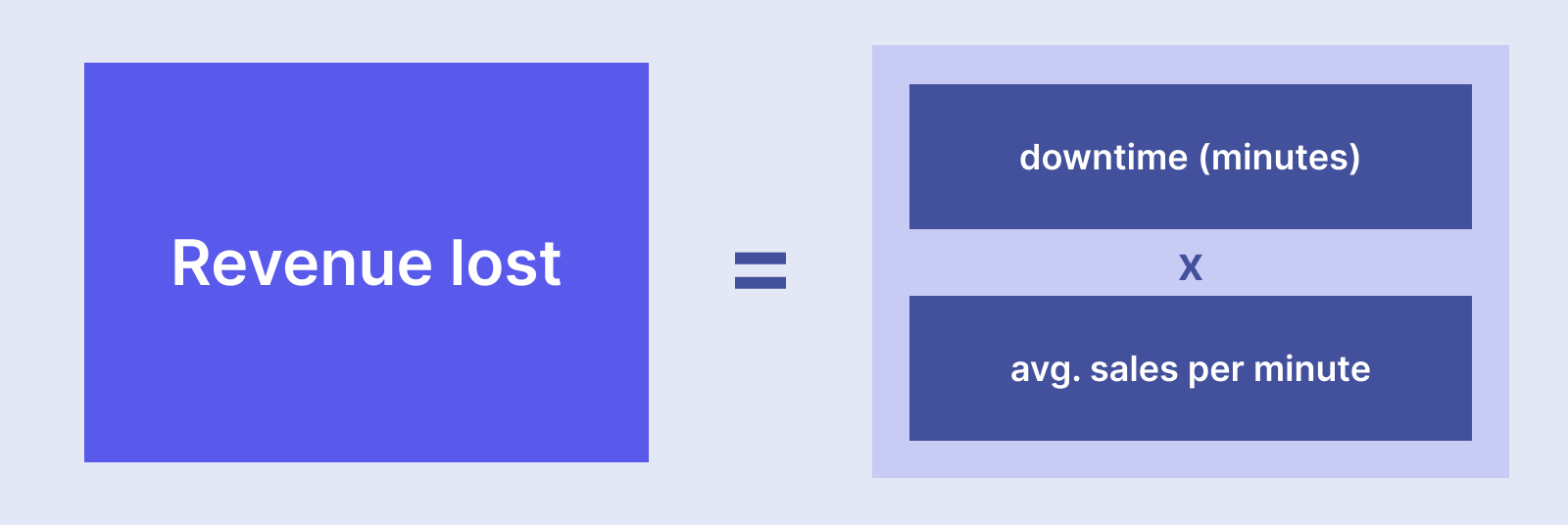
Every minute of downtime during a major sale puts revenue at risk, and peak-season traffic tends to surface performance issues that stay hidden the rest of the year. Two independent research findings put a number on how much that risk has grown industry-wide:
- The ITIC 2024 Hourly Cost of Downtime Report found that a single hour of downtime now costs more than $300,000 for over 90% of mid-size and large enterprises, and 41% report hourly downtime costs of $1 million or more.
- Uptime Institute's 2022 outage analysis found that over 60% of outages result in at least $100,000 in total losses, up from 39% in 2019, a trend that has continued to worsen in more recent editions of the same report.
Neither figure is retail-specific, but the underlying pattern applies directly: a checkout or payment failure that would be a minor incident on a normal Tuesday becomes a much larger loss when it happens during a traffic spike, because order volume, not just the error rate, is what determines the total cost.
Load testing and automated regression suites are how teams catch this before customers do. They simulate real user activity at volume, which is the only reliable way to find the bottlenecks that only appear under peak load. A retail team validating for its next major sales event should be running automated checks specifically against:
- Checkout speed under concurrent load
- Inventory accuracy during high-volume updates
- Payment processing reliability across providers
A general ROI framework for test automation
Automated testing lets retailers launch campaigns faster: when QA cycles move faster, more promotions ship on schedule instead of slipping past the window they were built for. Fewer bugs at launch also means fewer abandoned carts, fewer refund requests, and less support load, all of which are easier to defend in front of leadership than "QA velocity" on its own.
Break the ROI calculation into three levers rather than presenting automation as a flat cost-saver:
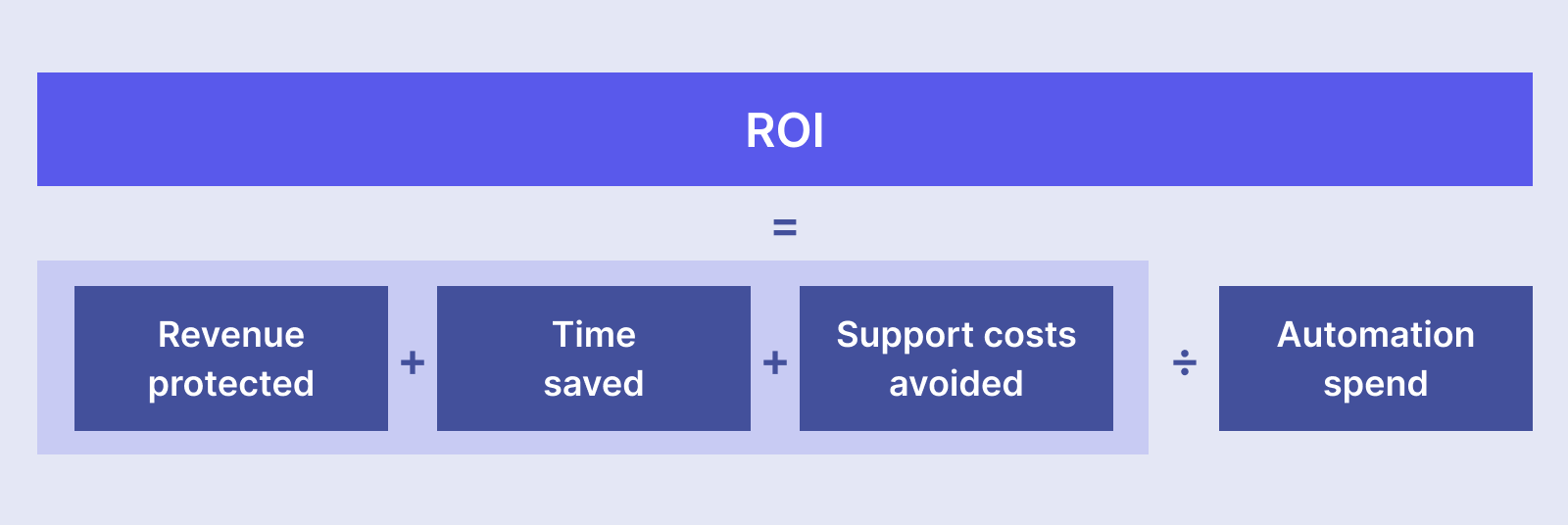
- Revenue protected: automated checks catch issues before they reach customers or cause an outage during a critical sales window.
- Time saved: automated tests run faster and more often than manual reviews, freeing the team to focus on new features instead of repeating the same checks.
- Support costs avoided: fewer bugs in production means fewer tickets, fewer refunds, and less time spent triaging instead of building.
Katalon's 2025 State of Software Quality Report also found that organizations with a strong QA strategy report 32% higher customer satisfaction, 24% lower operational costs, and 11% faster time to market, exactly the kind of cross-functional outcomes a business case needs to point to, since none of them are QA-only metrics.
Building your business case: mapping automation to executive KPIs
Every retailer has its own pain points: downtime disrupting the customer journey, failed checkouts slowing revenue growth, delayed promotions missing their sales window. Naming the specific pain point is the first step in a business case that lands, a generic "automation improves quality" pitch doesn't compete for budget as well as a pitch tied to a KPI leadership already tracks.
Map automation's benefits directly to those KPIs:
- Sales preserved: automated testing protects revenue by preventing outages and failed transactions during peak events.
- Conversion rate: a checkout process that runs smoothly without errors converts more of the shoppers who reach it.
- Uptime: consistent test coverage supports reliable performance during traffic surges, the metric leadership feels most directly.
Present the ROI in terms of revenue protection and growth, not just cost reduction. Automation earns renewed budget when each release becomes evidence for the case, not just a one-time pitch.
Choosing the right tool for e-commerce QA
Your test automation platform shapes how quickly your team can respond to market changes, so tool choice is a business decision, not only a technical one. A few criteria matter most for retail specifically:
- Scalability: automation needs to scale with your product catalog, covering every new feature and update without a proportional increase in QA headcount.
- Cross-platform and device coverage: retail traffic spans browsers, mobile devices, and operating systems, so the tool needs to test across all of them, not just one.
- CI/CD integration: testing needs to run inside the delivery pipeline to keep frequent releases safe rather than slowing them down.
- Low-code and no-code options: letting business analysts and product owners participate in testing, not just engineers, shortens the path from "we found a gap" to "it's covered."
Katalon True Platform brings these together with AI built into the workflow: the Katalon AI Assistant can generate test cases from requirements, run them autonomously, and flag failures for review, while self-healing locators absorb the constant UI changes that come with seasonal redesigns and promotional banners, exactly the kind of churn that breaks brittle test scripts the week before a big sale. See our guide on how to choose the right automation testing tool for the full evaluation framework beyond these retail-specific criteria.
Clear reporting matters just as much as the testing itself: dashboards that show the direct link between QA activity and business outcomes are what let decision-makers see the impact of automation on sales and customer experience, rather than taking it on faith.
Conclusion: QA as a revenue multiplier in retail
E-commerce test automation protects sales directly: automated QA prevents checkout failures and keeps systems stable during every campaign, and every smooth transaction is both revenue and a better customer experience. Quality assurance isn't overhead here, it's what lets a retail team grow and release with confidence instead of dreading the next peak-season deploy.
As you build this case for your own team, lead with the KPI your leadership already tracks, sales preserved during peak events, uptime, or release speed, and let each release become supporting evidence rather than re-making the pitch from scratch every quarter.

|
