




In 2026, software quality has become a CEO-level mandate, with 66% of CEOs report measurable business benefits from AI initiatives (according to IDC’s 2025 CEO Priorities research). However, a significant "quality gap" remains; Forrester reports that customer experience quality has reached an all-time low. To bridge this, Gartner predicts that 70% of enterprises will adopt AI-augmented testing by 2028. Meeting these rising expectations requires moving beyond traditional methods toward AI regression strategies that ensure stability at scale.
What is Regression Testing and Why is it Critical?
Regression testing is the practice of ensuring that recent code changes, updates, or bug fixes have not adversely affected existing features. It acts as a safety net against unintended side effects that could otherwise disrupt a stable application.
As Jason Lee, Partner and National Quality Engineering Lead at Deloitte Canada, stated on a webinar: "Assuring that updates or bug fixes do not break existing functionalities is paramount in the fast-paced software market. Regression testing provides that reassurance."
The goal is not just code correctness; it is about preserving the "True Goal" of the user experience. If business-critical flows—such as buying a product, transferring money, or booking a trip—remain intact, the company protects its revenue and prevents customer churn.
The Cracks in Traditional Regression Strategies
To manage regression testing, teams have historically relied on several strategies:
- Retest all: Running every test case to ensure maximum coverage, which is costly and time-consuming.
- Selection & prioritization: Choosing a subset of tests based on risk or recent changes.
However, these traditional methods suffer from an Efficiency Gap:

- Time-Consumption: Rerunning numerous test cases after every update can be labor-intensive and time-consuming.
- Optimization: Determining which test cases to execute after each code change can be challenging.
- Maintenance: The evolution of software demands the continuous upkeep and growth of the test suite, which can be demanding.
- Human fatigue: Regression testing, when done manually, is a monotonous and repetitive task that can lead to decreased attention and loss of motivation.
The "ROI Wall" and the Cost of Escaped Defects
A critical insight involves the "ROI Wall": For many teams, test automation efforts die after approximately two years. This happens because the effort to maintain those automated tests eventually outweighs the benefits, resulting in a negative ROI.

The financial stakes of this wall have reached a critical peak in 2025-2026, as the cost of escaped defects continues to escalate across the industry. The economic reality is stark: defects caught late in the development lifecycle cost exponentially more to resolve than those identified early, consuming not just engineering resources but triggering cascading business impacts.
These quality gaps lead to severe direct financial consequences: research from Tricentis indicates that 42% of organizations now lose more than $1 million annually due to subpar software quality. Furthermore, ITIC reports suggest that the operational impact is equally devastating, with the average cost of a single hour of critical application downtime now exceeding $300,000.
Moreover, the true cost of manual regression goes beyond labor hours; it's measured by the Customer Experience (CX) Gap. Escaped defects trigger negative consequences: customer churn, damaging reviews, and brand devaluation, that vastly outweigh the expense of early detection. While the cost of manual regression increases proportionally with product complexity, the impact of these defects is exponential.
The Automation Trap: Why UI Testing is So Hard
Teams rely on End-to-End (E2E) UI testing because it reflects the user's perspective. The assumption is that if the user flow works, the business gets value. However, this approach is fraught with challenges:
- Brittleness: UIs are subject to frequent changes. A simple UI update can break an entire suite of scripts.
- Ambiguity: Requirements are inherently ambiguous. It is difficult to design the "perfect" test case from a specification document alone.
- Complexity: Automation tools often struggle to recognize complex or custom UI elements, leading to false positives and flaky tests.
The Solution: Leveraging AI and Real-User Insights
To escape the maintenance trap, the industry is shifting toward AI-powered innovation that learns from production. The paradigm shift involves moving from validating against "ambiguous requirements" to validating against real user behavior.
By observing actual user interactions with an application, AI fundamentally transforms regression testing by moving beyond manual constraints.
Through automated test generation, AI analyzes user data and logs to autonomously create test cases, which effectively removes the need to manually script flows based on vague requirements. Its self-healing capabilities also allow the system to intelligently identify UI changes, such as dynamic locators, and automatically adapt test scripts to drastically reduce maintenance overhead.
To optimize effort, AI uses predictive analysis on historical data to identify defect hotspots, ensuring teams focus their testing where it matters most. Finally, AI-driven gap analysis identifies under-tested areas of the application, ensuring comprehensive coverage across the entire software suite.
📝 Learn more: Automated Regression Testing: Strategy, Tools & Best Practices
Spotlight on Katalon TrueTest: Automating What Actually Matters
Katalon TrueTest represents this leap forward. It is a solution designed to capture production user interactions and autonomously generate and maintain test cases.
By integrating TrueTest, teams can realize specific benefits:
- Eliminating Guesswork: It replaces subjective test selection with data-driven tests based on actual user journeys, ensuring you are testing what users are actually doing.
- Focus on Growth: The tool allows development teams to focus on testing new growth-driving features, while AI autonomously protects the existing business-critical flows.
- Augmentation, Not Replacement: The tool puts humans in the driver's seat by removing mundane tasks, allowing testers to focus on strategic initiatives.
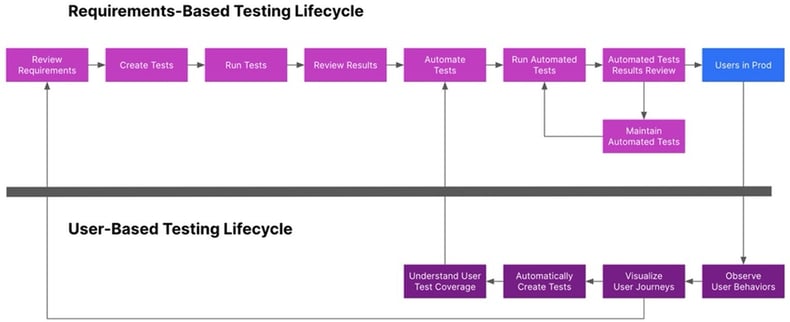
The future of regression testing is not just about more automation; it is about intelligent automation. By integrating AI that learns from real user behavior, teams can overcome the "negative ROI" of brittle scripts and ensure user satisfaction.
We encourage you to stop maintaining scripts manually and experience the future of quality assurance. Learn more about TrueTest here to see how AI-driven regression testing can accelerate your release cycles.
|
